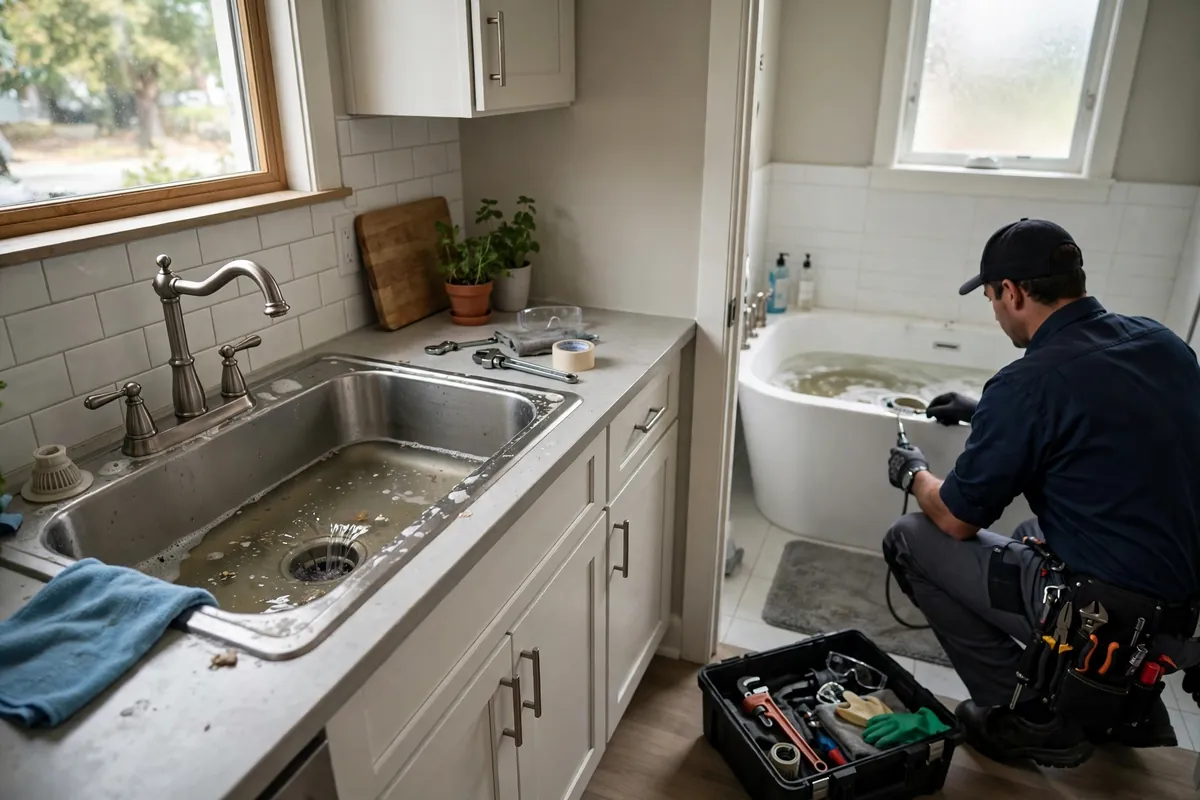
A main line clog is a blockage in the pipe that carries all of your home's wastewater out to the city sewer. A sewer backup is what happens when wastewater can no longer get out and starts flowing back into your home through drains, tubs, or toilets. In most cases the clog is the cause and the backup is the result — though a backup can occasionally come from the city sewer side during heavy rain.
If sewage is already entering your home, stop using every drain and toilet, avoid contact with the wastewater, and call a professional. Sewage carries harmful bacteria and should never be handled without professional equipment.
Think of it as direction: a main line clog stops water from flowing out, while a sewer backup pushes wastewater back in. Drains that are slow or gurgling across several fixtures point to a clog; water or sewage rising in a tub, shower, or floor drain points to a backup. Either way, stop using water fixtures and call a professional — a clog becomes a backup if you wait.
In This Article
What To Do Right Now
Stop using every water fixture in the home right away — toilets, showers, sinks, the washing machine, and the dishwasher. When the main line is blocked, every gallon you send down a drain has nowhere to go, so it looks for the lowest exit it can find and comes back up there.
If you see or smell sewage, keep everyone away from it, including pets. Do not mop it, vacuum it, or try to push it back down the drain. Sewage carries bacteria and other contaminants, and safe cleanup requires professional equipment, protective gear, and proper disinfecting.
Do not pour chemical drain cleaner into any drain. These products cannot dissolve a main line blockage, and if the water backs up, the chemicals back up with it — which can burn skin and damage fixtures.
You can glance at your outdoor sewer cleanout, usually a capped pipe sticking up near the house or property line, but only look. If water or sewage is seeping out around the cap, leave it alone. Forcing the cap off can release a surge of wastewater across your yard.
Then call a professional. We have served Leesburg for 19 years, and the professionals we connect you with carry camera equipment that pinpoints the blockage without digging or guessing.
If sewage is coming up through any drain or toilet, stop using all water in the home and call (352) 703-8206 — we're available 24/7 and typically arrive within 30–45 minutes in Leesburg.
Signs To Look For
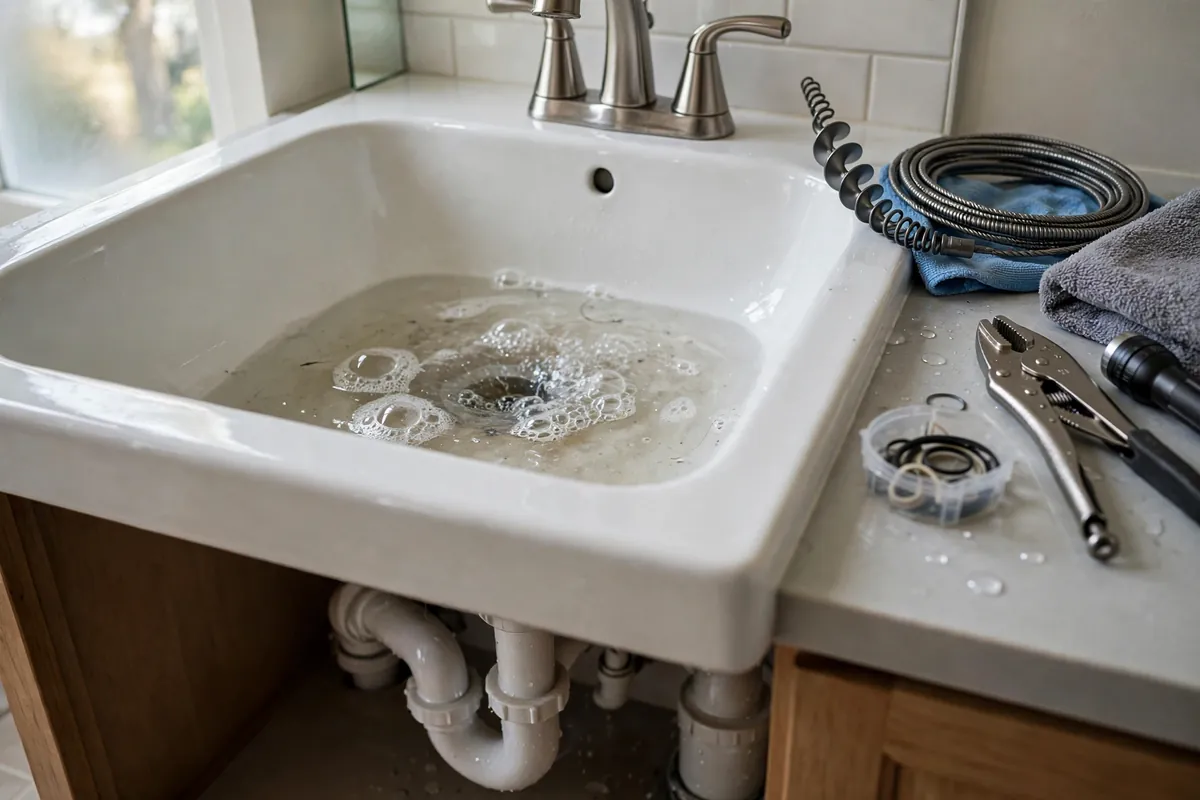
A main line clog and a sewer backup share some symptoms, but the pattern tells them apart. A developing clog usually shows up first as slow drainage: several fixtures drain slowly at the same time, the toilet gurgles when the washing machine drains, or the water level in the toilet bowl rises and falls on its own.
A sewer backup looks more dramatic. Wastewater rises in the lowest fixture in the home — often a shower, bathtub, or floor drain — even though nobody ran water there. You may notice a strong sewage odor paired with standing water, or dirty water pooling around a laundry room floor drain.
The most reliable clue is the lowest-drain rule. Wastewater under pressure seeks the lowest available exit, so the fixture that misbehaves first is usually the lowest one on the main line. An upstairs sink that drains slowly while a downstairs shower fills with gray water points to the main line, not the sink.
Watch for fixtures affecting each other. A toilet that bubbles when someone showers, or a tub that gurgles when a toilet flushes, means air is trapped in the line by a blockage downstream of both fixtures — a classic main line signature. A single slow drain with everything else working normally usually means a local clog in that fixture's own branch.
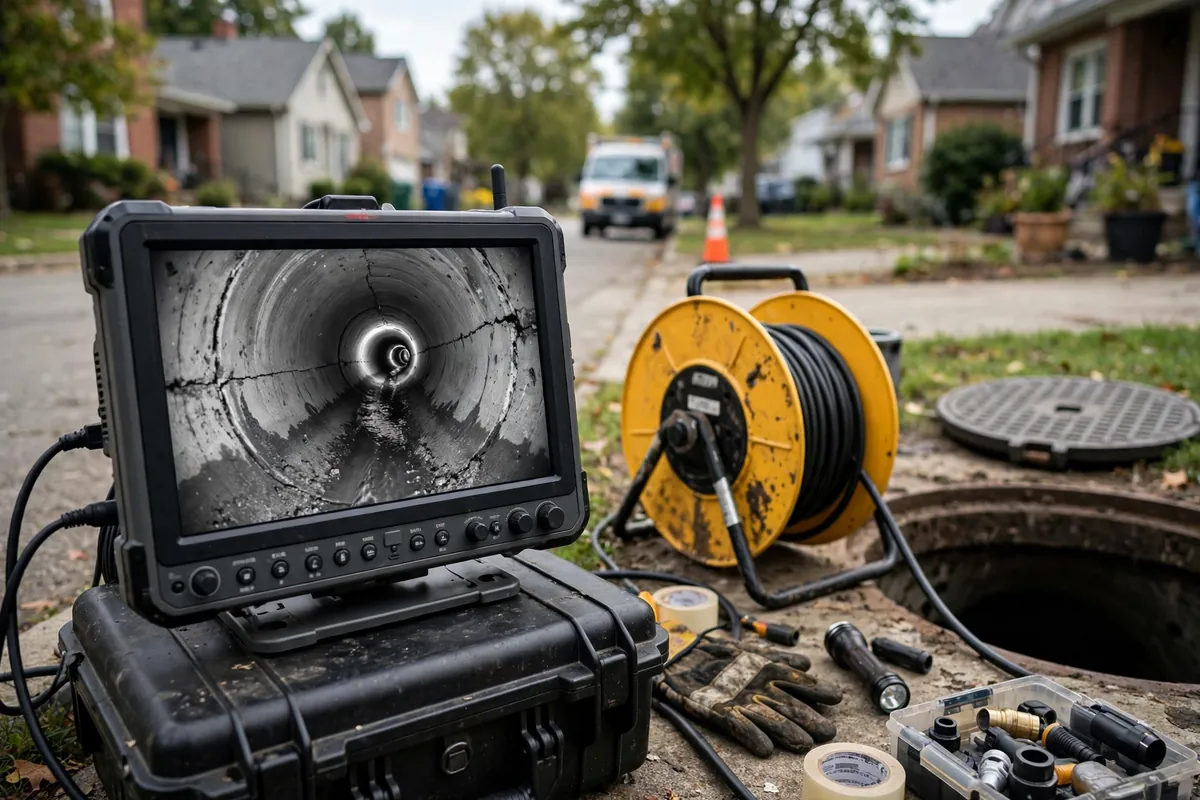
Your outdoor cleanout adds one more clue. If water is visible around the cap or seeping from it, the blockage likely sits between your house and the street. If the cleanout area is dry while fixtures back up inside, the blockage may be closer to the house. Either way, the next step is a sewer camera inspection to see exactly what is going on.
Common Causes
Tree roots cause a large share of main line clogs in Leesburg. Roots seek out moisture, and they find it through tiny cracks or loose joints in sewer pipes. Once a root hair enters, it grows into a dense mass that catches everything flowing past. Older clay or cast-iron lines are the most vulnerable, but roots can exploit any weakened joint. Our guide to tree roots and underground pipes explains how this starts.
Anything flushed that should not be flushed builds up the same way. So-called flushable wipes do not break down like toilet paper, and neither do paper towels, hygiene products, or cotton swabs. Each one that makes it through adds to a growing snag inside the pipe.
Grease is the kitchen's contribution. Hot grease poured down the drain looks harmless as a liquid, but it cools and hardens inside the pipe, coating the walls layer by layer until the opening narrows enough to catch solids.
The pipe itself can be the problem. A sagging section — called a belly — lets waste and water pool instead of flowing through. Cracked or collapsed sections, often in older pipes or where soil has shifted, create edges that snag debris. Mineral scale can narrow the inside of aging metal pipes over many years.
Sometimes the backup starts on the city side. During heavy Florida rain, the municipal sewer can surcharge, pushing water back toward homes faster than it can drain away. This is less common than a blockage in your own line, but a camera inspection can tell the difference — which matters, because the fix depends on where the problem sits. Our main line clog service always starts with that inspection so the repair targets the real cause.
What Happens If You Wait
A partial clog does not stay partial. Every flush and every load of laundry adds material to the blockage, and the slow drains you notice today become standing wastewater tomorrow. The transition from clog to full backup can happen gradually — or all at once when a large discharge, like a washing machine cycle, hits the narrowed section.
Once wastewater enters the home, the damage spreads quickly. Sewage soaks into flooring, drywall, baseboards, and anything stored low. Porous materials that contact sewage generally cannot be cleaned safely and must be removed by professionals, which turns a plumbing repair into a restoration project.
Standing wastewater also creates conditions where mold can grow, especially in Florida's humidity. And the pressure of backed-up water against a cracked or weakened pipe can widen the damage, turning a cleanable blockage into a broken pipe that needs repair.
The practical point is simple: a main line clog caught early is usually a straightforward clearing job. The same clog ignored becomes sewage in the home, damaged finishes, and a much larger disruption. If several fixtures are slowing down together, that is the moment to act — not after the tub starts filling. Emergency main line help is available around the clock when the situation cannot wait.
Safe DIY Checks Vs When To Call A Professional
There is a short list of things you can safely check yourself, and a much longer list that belongs to a professional. Use this guide to stay on the safe side.
| What You Notice Or Want To Do | Safe To Handle Yourself | Call A Professional |
|---|---|---|
| Several fixtures draining slowly | Yes — note which ones; the pattern helps the technician | If the list keeps growing or sewage appears |
| Looking at the outdoor cleanout cap | Yes — look only, from a safe distance | If water or sewage is coming out around it |
| Running water to test a drain | No — added water can push sewage back up | Call instead of testing |
| Plunging a toilet | Only if it is the only fixture affected | If other fixtures gurgle or back up too |
| Pouring chemical drain cleaner | No — it cannot clear a main line and can burn on backup | Always call instead |
| Snaking the main line with rental equipment | No — rental augers can damage pipes or get stuck | A professional auger or jetter is the safe option |
| Cleaning up backed-up sewage | No — sewage requires professional handling | Always — this is never a DIY job |
How The Service Fixes It
A professional fix starts with seeing the problem. Our technician runs a sewer camera inspection through the line, which shows the exact location and nature of the blockage — roots, grease, a belly, or a break — on a live monitor. Guessing wastes time and money; the camera removes the guesswork.
Once the cause is visible, the technician clears it with professional equipment. A heavy-duty auger cuts through root masses and solid obstructions, while hydro jetting uses high-pressure water to scour grease and buildup from the pipe walls. The right method depends on what the camera found, which is why the inspection comes first.
Clearing the blockage is only half the job if the pipe itself is damaged. Cracks, root entry points, and corrosion can be repaired from the inside with epoxy pipe lining, which creates a smooth new pipe within the old one without digging. More severe damage may need a section repair — the camera footage lets you see exactly what you are dealing with before deciding anything.
After the work, the technician runs the camera through once more to confirm the line is fully open and flowing. You get a clear explanation of what was found, what was done, and what to watch for going forward.
If wastewater is already backing up into your home, do not wait for business hours. Our emergency main line service runs 24/7, and we typically arrive within 30–45 minutes anywhere in Leesburg. For recurring slow drains that have not yet become an emergency, our main line clearing service handles the full diagnosis and clearing in one visit. And if multiple drains are backing up at once, that pattern alone is reason enough to call.