Hidden leaks in commercial buildings rarely show themselves directly. Instead they surface as a water bill that keeps climbing, a musty smell in a hallway, ceiling tiles that stain and sag, or tenants reporting damp spots. Because commercial plumbing runs through walls, slabs, and ceiling plenums, a small leak can run for weeks before anyone connects the clues.
If you manage or own a commercial building in Leesburg, these are the warning signs worth acting on — and what to do when you see them.
The most reliable early warnings are a rising water bill with no change in usage, recurring stains on ceilings or walls, musty odors, and warped flooring or baseboards. Check your water meter for movement when the building is quiet, document what you find, and call a professional leak detection service — hidden leaks get more expensive the longer they run, but the fix starts with an accurate location.
In This Article
What To Do Right Now
If water is actively spreading — through a ceiling, across a floor, or near electrical equipment — and you can reach the building's main water valve safely, shut it off. Then keep people away from the affected area, especially if water is near electrical panels or outlets, and call for help. Do not enter a flooded electrical room or touch wet electrical equipment.
If you are seeing warning signs rather than active flooding — stains, odors, a climbing bill — do not shut down the building. Instead, document everything: photograph each symptom, note dates, and pull recent water bills for comparison. Then check the water meter during a quiet period with everything off; a moving meter confirms water is going somewhere it should not.
Move vulnerable items away from the affected area — inventory, electronics, paper records — but do not open walls or ceilings yourself to look for the leak. Exploratory demolition without a location usually causes more damage than the leak has, and it destroys the evidence a detection technician uses.
Then call a professional. We have served Leesburg for 19 years, and our commercial leak detection service locates hidden leaks with non-invasive equipment — no exploratory demolition needed.
If water is actively spreading through ceilings, walls, or electrical areas, shut off the building's main water valve if you can do so safely and call (352) 703-8206 — we're available 24/7.
Signs To Look For
The water bill is often the first witness. A bill that climbs month after month with no change in occupancy, hours, or operations means water is being used — or lost — somewhere. Compare at least a year of bills to separate a real trend from seasonal variation, and remember that a slow leak runs twenty-four hours a day, which adds up faster than most people expect. Our high water bill leak service uses the same meter-check logic to confirm hidden loss before detection begins.
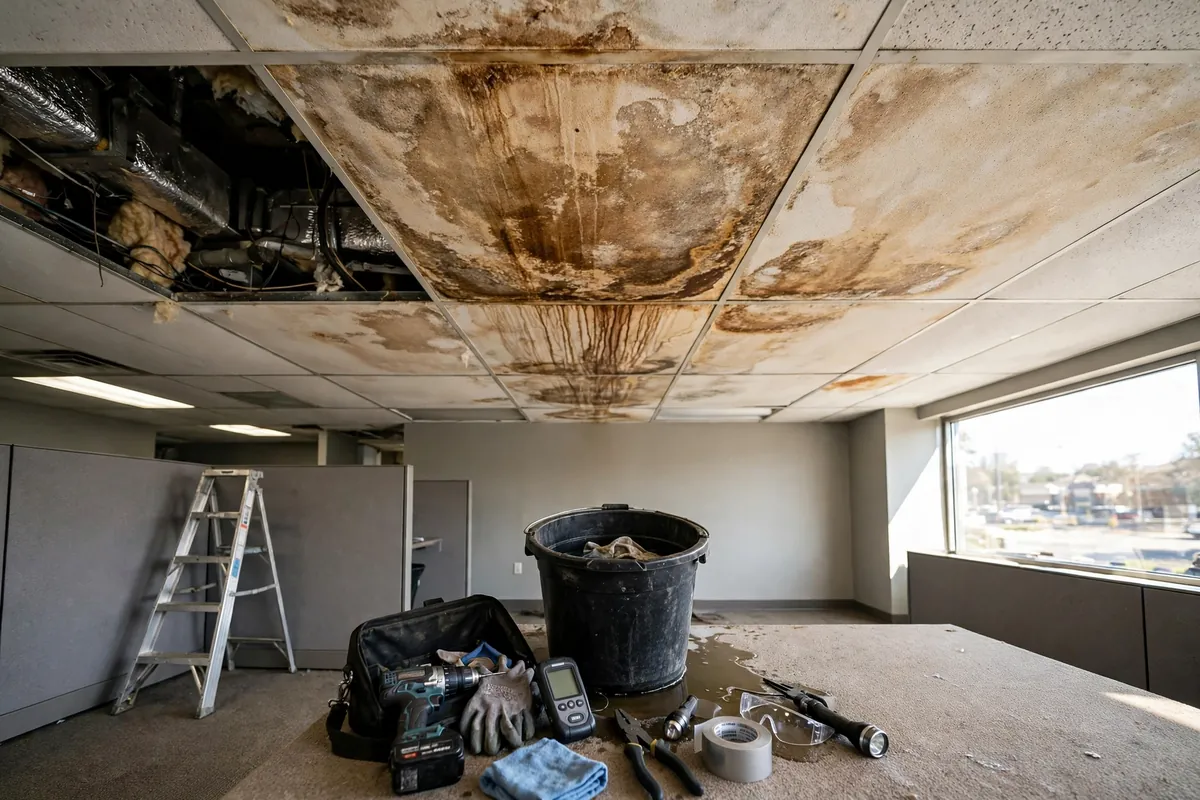
Ceiling tiles tell the next chapter. In commercial buildings with drop ceilings, the tiles are the canary: a tile that stains, sags, or grows discolored spots is sitting under moisture. Because water travels along pipes, joists, and the top of the ceiling grid, the leak itself may be several feet from the stained tile — the stain marks where water dripped, not where it started.
Musty odors in hallways, restrooms, or storage areas signal hidden moisture even when nothing looks wet. Trust the smell and look harder: behind access panels, above the ceiling grid, inside janitor closets. Warped flooring, bubbling paint, and baseboards pulling away from walls are the same story told by different materials — each one means water has been present long enough to damage finishes.
Tenant complaints deserve weight. Tenants notice damp spots, dripping sounds, and running-water noises in walls long before management does — they live with the building all day. A tenant reporting the sound of running water when everything is off is describing a pressurized leak, and it deserves immediate attention.
Outside, look for landscaping near the building that stays wet without irrigation, or pavement that never quite dries. A service line or irrigation leak against the foundation shows itself in the soil before it shows itself in the building.
Common Causes
Aging supply lines are the most common source. Commercial buildings often have decades-old copper, galvanized, or polybutylene supply piping running through walls and slabs, and every year adds corrosion, mineral wear, and stress at joints. A pinhole leak in a wall cavity can spray a fine mist for weeks — invisible, but steadily soaking everything around it.
Slab leaks deserve special mention in Florida construction. Water lines run beneath the concrete slab in many commercial buildings, and a leak there follows the path of least resistance — sometimes surfacing far from the break as damp flooring, warm spots on the slab, or moisture wicking up through expansion joints.
Restroom supply lines and valves fail in the most-used rooms in the building. A leaking toilet supply line, a cracked flush valve, or a deteriorated shutoff can run unnoticed inside a wall or above a ceiling, especially in restrooms that get cleaned around rather than inspected.
Water heaters and boilers in mechanical rooms develop tank and fitting leaks with age. Rooftop and mechanical equipment adds condensate lines that clog and overflow — technically not a plumbing leak, but it produces identical ceiling stains below. Irrigation systems cross-connected near the building can leak against the foundation and wick moisture inside.
Not every wet sign is a supply leak. Condensation on cold pipes or ducts in humid spaces mimics leak staining, and roof leaks produce ceiling stains identical to plumbing leaks. Sorting these out is exactly what professional detection does — the treatment for each is completely different, so the diagnosis has to come first.
What Happens If You Wait
Hidden leaks do not stabilize; they expand the damage zone. Water keeps wicking outward through drywall, insulation, and flooring, so a stain that started as a dinner-plate circle becomes a sagging ceiling section. Every week of delay adds square footage to the eventual repair — of the finishes, not just the pipe.
Prolonged moisture creates conditions where mold can grow inside wall cavities and above ceilings — places nobody sees until the problem is advanced. In tenant-occupied buildings, that becomes a tenant relations problem on top of a maintenance problem, and remediation in an occupied space is far more disruptive than a prompt pipe repair.
The water bill keeps running the entire time. A moderate hidden leak wastes thousands of gallons a month, and commercial water rates make that an expensive way to learn about a problem. There is also the structural side: water eroding soil under a slab, rotting wood framing, corroding metal components — slow damage that is cheap to prevent and expensive to reverse.
None of this requires panic — it requires a phone call. A hidden leak found this month is a located leak and a targeted repair; the same leak found next quarter is a restoration project. The difference is timing, and timing is entirely within your control.
Safe DIY Checks Vs When To Call A Professional
Building staff can safely gather information; locating and repairing the leak belongs to professionals. Here is the line.
| What You Can Do | Safe For Building Staff | Call A Professional |
|---|---|---|
| Photographing stains, damage, and wet areas | Yes — date every photo | — |
| Checking the water meter during quiet hours | Yes — note whether it moves with everything off | If it moves and you cannot find the source |
| Comparing twelve months of water bills | Yes — look for an unexplained upward trend | If the trend is clear and steep |
| Listening for running water in walls | Yes — report what you hear and where | To pinpoint the exact location |
| Opening walls or ceilings to find the leak | No — exploratory demolition causes more damage | Always — detection first, then targeted repair |
| Shutting off the building's main water valve | Only in an active emergency, if safely reachable | If you are unsure where the valve is or it is stuck |
| Using the leak location to plan repairs | — | After professional detection confirms the spot |
| Drying out wet areas with fans | Yes — after documenting, for surface moisture | If moisture is inside walls or above ceilings |
How The Service Fixes It
Professional commercial detection is methodical, not destructive. The technician starts with your documentation — symptoms, bills, meter readings — and a walkthrough of every affected area. Then the instruments come out: acoustic listening for pressurized leaks in walls and slabs, thermal imaging to scan large surfaces for moisture anomalies, moisture meters to map how far dampness has spread, and pressure testing to confirm a supply line is actually losing water.
Each method cross-checks the others. A thermal anomaly plus a moisture reading plus an acoustic signal at the same location is a confident pinpoint — accurate enough to mark an exact spot for repair. That precision is the whole value of the service: the repair opens one small area instead of exploratory holes across the building.
You receive a written report with the location, the evidence, photos, and recommended next steps — documentation that works for ownership, insurers, and repair contractors alike. Our guide to what commercial leak detection involves walks through the full process from intake call to final report.
If the leak also affects scheduling — a restaurant kitchen, an occupied office — our guide to minimizing downtime during repairs covers keeping the business running while the fix happens. And when water is actively spreading and cannot wait, our emergency commercial service runs 24/7 with typical arrival in 30–45 minutes anywhere in Leesburg.